


How the HQY-20 Closed Circuit Sampler Works
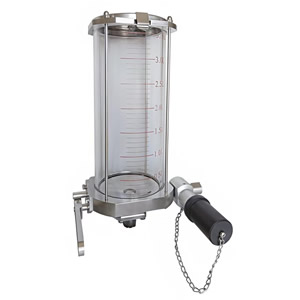
The HQY-20 forms a sealed sampling circuit between the fuel storage tank and the settling sump. Fuel leaves the tank outlet valve and enters the sampler through the 3/8” inlet connection, swirling into the vertical graduated glass cylinder. During filling — and while the fuel rests in the cylinder — the operator can directly observe colour, clarity and suspended contaminants through the glass wall.
Three quality checks are performed with one device:
- Fuel cleanliness check — with the top cover closed and the ball valve handle in the horizontal (closed) position, open the fuel inlet valve. Fuel swirls into the glass cylinder; close the inlet when the level reaches no more than 80% of the cylinder height. Observe colour and turbidity to detect particulate contamination. Afterwards, turn the ball valve handle to the vertical (open) position and drain the fuel to the settling sump through the 3/4” bottom connection.
- Free-water check — remove the dust cap from the sampling port, wipe it clean and push a Shell water detector into the port. The detector head depresses the internal press valve; tilt the detector tail into the positioning slot and draw a small fuel sample. If the test paper on the detector head changes colour, free water is present in the fuel.
- Density & temperature check — read the hydrometer and thermometer immersed in the fuel inside the graduated cylinder to confirm product quality.
The anti-drop device at the fuel outlet prevents the Shell water detector from accidentally falling into the pipeline during sampling.
Key Technical Specifications
| Parameter | Specification |
|---|---|
| Model | HQY-20 Closed Circuit Sampler |
| Cylinder capacity | 3.6 L (3600 mL), graduated scale 0.5–3.5 L |
| Working temperature | −40 °C to +60 °C |
| Bottom (drain) valve pressure | ≤ 1.0 MPa |
| Working medium | Aviation kerosene (Jet A-1 / RP-3), gasoline and other non-corrosive liquids |
| Wetted materials | Stainless steel (cylinder guard, base, valve group, fittings); high-grade aluminium alloy (sampling head assembly) |
| Water detector port | Shell water detector; positioning distance 70 ± 0.5 mm; detector capacity 0–5 mL |
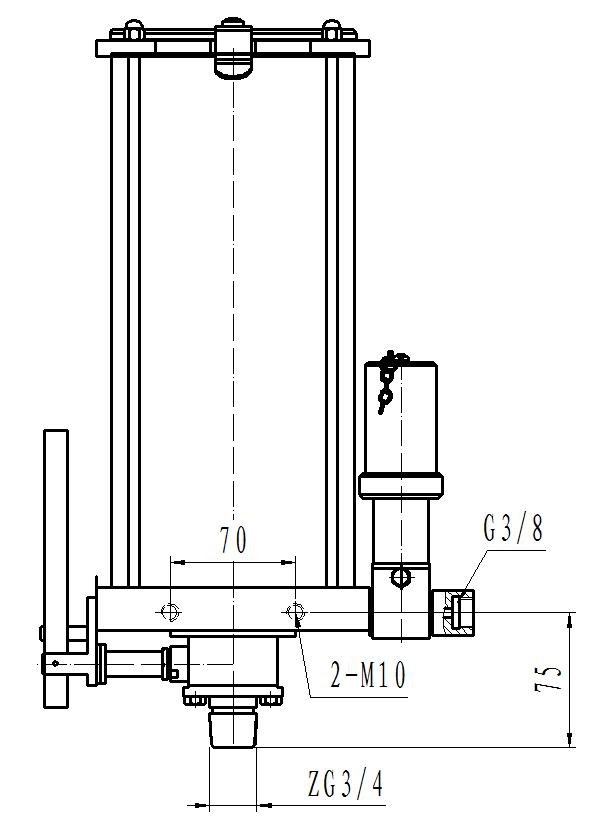
| Connections | G3/8” fuel inlet (downstream of tank outlet valve); ZG3/4” drain flange to settling sump; 2 × M10 base fixing bolts |
| Installation | Glass cylinder in vertical position; base fixed to positioning plate with 2 × M10 bolts |
| Overall dimensions | 415 × 239 × 172 mm |
| Net weight | 5.6 kg |
Construction & Key Features
- Corrosion-free sampling path — all parts in contact with fuel are made of stainless steel, except the sampling head assembly in high-grade aluminium alloy, so the fuel under test is never contaminated or emulsified.
- Stainless steel base — easy to wash down and keep clean in fuel-lab environments.
- CNC-machined key components — critical parts are manufactured on CNC machine tools for consistent fit and sealing.
- Standard ball-valve set — uses off-the-shelf ball valves, improving working reliability and extending service life; spares are locally available.
- Graduated glass cylinder — wall-printed scale (0.5–3.5 L) allows direct reading of sampled volume.
- Water-detector anti-drop device — prevents the Shell water detector from dropping into the fuel line during the water check.
- 100% factory tested — every unit passes a high-pressure leak test and full quality inspection before shipment.
Installation
- Mount the sampler with the glass cylinder in the vertical working position; fix the two M10 screw holes on the lower base to the positioning plate with two M10 bolts.
- Connect the 3/4” pipe joint on the drain flange under the base to the aviation-fuel settling sump with a secure pipeline.
- Connect the 3/8” fuel inlet joint downstream of the fuel outlet valve of the storage tank.
- Open the top cover and insert the hydrometer and thermometer into the glass cylinder, positioning them centrally.
Common Applications
- Airport fuel farms & storage depots: routine quality control of Jet A-1 / RP-3 in cone-roof and floating-roof storage tanks
- Aircraft refuelling systems: hydrant systems, refueller trucks and hydrant-dispenser quality checks
- Fuel laboratories: visual cleanliness, free-water and density/temperature verification before release
- General duty: closed sampling of gasoline and other non-corrosive, non-viscous liquids in storage tanks
Quality Assurance & Standards
Each HQY-20 sampler is manufactured at our Honghu, Hubei facility and is 100% pressure- and leak-tested before delivery, with full material traceability. The operating procedure described above — visual cleanliness check, water-detector test and density/temperature reading — follows common aviation-fuel quality-control practice consistent with the manual sampling principles of ASTM D4057 / API MPMS 8.1.
For pressurised closed sampling of process lines and pipelines (LPG, naphtha, crude, refined products), see our Closed Sampler for Liquid and the full range in Closed Loop Samplers.
Related products
- Sampling System
Storage Tank Sampler
- Closed Loop Samplers
Petroleum Pipeline Automatic Sampler
- Closed Loop Samplers
Cylinder Sampling for Gas


 English
 Russian
 Arabic
 Spanish
 Portuguese
 Chinese