






Industrial Flame Arrestors for Tank Venting and Pipeline Safety
A flame arrestor is a passive safety device that prevents the propagation of a flame from one side of the device to the other, protecting storage tanks, pipelines, and process equipment from fire and explosion. Flame arrestors work by quenching the flame through a matrix of narrow passages — typically crimped metal ribbon — that dissipate heat below the autoignition temperature of the flammable vapor. Wanan Technology manufactures ISO 16852 and ATEX certified flame arrestors for atmospheric storage tanks, pipeline venting systems, and chemical process applications serving the petrochemical, oil and gas, and specialty chemical industries globally.
Without a flame arrestor, a tank vent exposed to an ignition source can ignite tank vapor and propagate a flame back into the vapor space — with catastrophic consequences. Installing the correct flame arrestor type, sized for the vapor group and pipe diameter, is one of the most cost-effective fire prevention measures in any hydrocarbon storage or transfer facility.
Key Features of Wanan Flame Arrestors
- Crimped metal ribbon element provides a high ratio of surface area to open area, efficiently quenching flames across Group IIA, IIB, and IIC vapor groups including hydrogen.
- ISO 16852 and ATEX certified with third-party testing by recognized notified bodies, accepted by international operators, EPC contractors, and insurance authorities.
- End-of-line and in-line configurations cover tank vent pipes (deflagration) and pipeline service (deflagration and detonation) in a single product family.
- Stainless steel 304, 316L, and carbon steel construction with optional alloy trim for corrosive, offshore, and cryogenic service.
- Flanged ANSI and DIN connections from 1 inch to 24 inches, accommodating most existing vent pipe and pipeline configurations.
- EAC certified for Russia, Kazakhstan, Belarus, and CIS project requirements — a key differentiator for Caspian, Siberian, and Central Asian installations.
Types of Flame Arrestors
Selecting the correct flame arrestor type requires matching the device to the installation point, vapor group, and piping configuration:
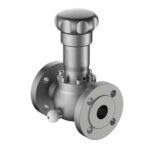
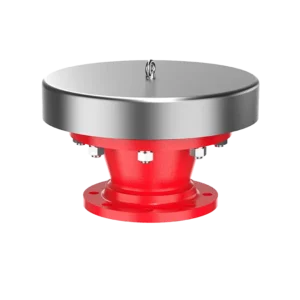
- End-of-line flame arrestor (deflagration) — installed on atmospheric tank vent pipes where the vapor cloud is exposed to open air. Prevents a surface ignition (flash fire or direct flame) from entering the tank through the vent nozzle.
- In-line deflagration arrestor — installed in a closed pipeline to stop a deflagration wave traveling from an ignition source toward a protected vessel or piece of equipment.
- In-line detonation arrestor — installed in long pipeline runs where a deflagration can accelerate to detonation velocity. The element must withstand the shock wave and hydraulic hammer of a sustained detonation event.
- Combination PVRV and flame arrestor — integrates a pressure vacuum relief valve with an end-of-line flame arrestor in one assembly, reducing installation footprint and connection points on the tank vent nozzle.
For storage tanks requiring both venting and fire protection, Wanan recommends combining a pressure vacuum relief valve with an end-of-line flame arrestor certified to ISO 16852 Group IIA or IIB, depending on the stored product.
Specifications
| Model | Type | Size Range | Vapor Group | Body Material | Standard |
|---|---|---|---|---|---|
| W-EOL-01 | End-of-Line | 2" – 20" | IIA / IIB | SS 304 / CS | ISO 16852 / ATEX |
| W-ILD-01 | In-Line Deflagration | 2" – 16" | IIA / IIB / IIC | SS 316L | ISO 16852 / ATEX |
| W-DET-01 | In-Line Detonation | 2" – 12" | IIB / IIC | SS 316L / Special Alloy | ISO 16852 / ATEX IIB/IIC |
Applications
Wanan flame arrestors protect hydrocarbon and chemical facilities across the full range of industrial applications:
- Atmospheric crude oil, gasoline, diesel, and solvent storage tanks
- Tank farm vent headers and manifolds
- LNG and LPG vaporizer and loading arm vent systems
- Biogas upgrading, methane and hydrogen pipeline systems
- Chemical plant reactor vent and off-gas systems
- Offshore FPSO and platform vent mast and flare knockout systems
Certifications and Standards
All Wanan flame arrestors are designed and tested to internationally recognized standards:
- ISO 16852 — Flame arresters: Performance requirements, test methods and limits for use (the primary global standard for flame arrestor certification and testing).
- EN 12874 — European standard for flame arrestors, which preceded ISO 16852 and remains referenced in many European project specifications.
- ATEX Directive 2014/34/EU — Equipment for potentially explosive atmospheres certification for EU and EEA markets.
- EAC (CU TR 012/2011) — Eurasian Conformity for Russia, Kazakhstan, Belarus, and other CIS countries.
How to Select a Flame Arrestor
- Identify installation type. End-of-line (tank vent) or in-line (pipeline). In-line applications must be further classified as deflagration or detonation service depending on pipe length and layout.
- Determine vapor group. IIA (propane, toluene), IIB (ethylene, hydrogen sulfide), or IIC (hydrogen, acetylene). Select an element certified for the correct group.
- Calculate flow capacity. Size the bore and element to handle the maximum normal and emergency venting flow without excessive pressure drop.
- Select materials. Match body and element materials to the stored fluid, temperature, corrosion potential, and environmental conditions.
- Specify certifications. Confirm ISO 16852, ATEX, EAC, or other regional approvals required by the project and jurisdiction.
Frequently Asked Questions
What is the difference between a deflagration and a detonation arrestor?
A deflagration arrestor stops a subsonic flame front. A detonation arrestor is designed to withstand a supersonic shock wave (detonation) and the much higher pressure and temperature loads associated with it. Detonation arrestors are required on long pipeline runs where a flame can accelerate to detonation velocity before reaching the arrestor.
What standard governs flame arrestor selection?
ISO 16852 is the primary international standard for flame arrestor performance testing and certification. EN 12874 is its European predecessor and is still referenced in many project specifications.
What vapor groups do Wanan flame arrestors cover?
Wanan supplies flame arrestors certified for vapor Group IIA (propane equivalent), IIB (ethylene equivalent), and IIC (hydrogen/acetylene equivalent) in end-of-line and in-line configurations.
Can a flame arrestor be combined with a pressure vacuum relief valve?
Yes. Wanan provides combination units that integrate a pressure vacuum relief valve with an end-of-line flame arrestor in a single housing, saving space and reducing connection points on the tank vent nozzle.
What certifications are required for projects in Russia and CIS countries?
EAC (CU TR) certification is required. Wanan flame arrestors hold EAC approval, making them eligible for direct use on Russian, Kazakhstani, and Belarusian projects without re-certification.
How often should flame arrestors be inspected?
ISO 16852 and manufacturer guidelines typically recommend annual inspection of the element for fouling, corrosion, or damage. Frequency may increase if the process fluid has high particulate content or corrosive components.
Contact Wanan Technology for a flame arrestor quotation or technical support.
 English
 Russian
 Arabic
 Spanish
 Portuguese
 Chinese