






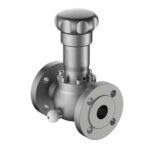
Low-Leakage Pressure Vacuum Relief Valves: Why Leak Rate Matters
Most tank venting specifications focus on capacity — can the valve pass enough vapor to prevent overpressure? But for operators facing tightening emissions rules and product-loss targets, the more important number is often the leak rate. A low-leakage pressure vacuum relief valve keeps the tank sealed below its set point, converting a passive safety device into an active barrier against fugitive emissions.
This article explains what leak rate is, why it matters more than ever under modern emission rules, and how to evaluate a low-leakage PVRV design.
What Is Leak Rate?
In tank venting, two related terms appear:
- Leak rate — the volume of vapor that passes through a closed valve below its set pressure, usually expressed in cubic feet per hour (SCFH) or normal cubic metres per hour (Nm³/h) at a stated differential pressure.
- Set pressure — the differential at which the pallet lifts and the valve opens to flow.
A standard PVRV may leak only slightly at low differential and still be “API 2000 compliant” for capacity. A low-leakage PVRV uses a flexible diaphragm or precision seat to keep leakage near zero across the full pressure range up to the set point. On a tank that breathes hundreds of times a month, that difference accumulates.
Why Leak Rate Matters Under Modern Emission Rules
Fugitive emissions from storage tank vents are increasingly regulated. Under US EPA Method 21 and leak-detection-and-repair (LDAR) programs, and under tightening EU and national VOC rules, a tank vent is treated as a potential emission point. Several forces drive the shift toward low-leakage valves:
| Driver | Effect on Tank Venting |
|---|---|
| VOC / LDAR regulations | Measurable leakage counts as a recordable emission source |
| Product-loss economics | Every leaked vapor litre is lost product and revenue |
| Odor and community complaints | High-leak valves cause perceptible odor at the vent |
| Carbon / flare management | Reduced venting lowers the site’s reported emissions inventory |
For tanks storing volatile products such as gasoline, naphtha, or solvents, the cumulative product loss through a leaking vent can be substantial, and regulators in several jurisdictions now expect demonstrable low-leakage performance at the vent.
How Low-Leakage PVRVs Are Built
The design features that produce a low leak rate are specific and measurable:
- Tensioned PTFE or FEP diaphragm seals that provide a soft, conforming seat with minimal seating force and excellent chemical resistance.
- Precision-machined seats with tight flatness tolerances to avoid the hairline gaps that cause leak-by.
- Guided pallet assemblies that prevent the pallet from tilting off-seat, a common cause of uneven leakage.
- Stated leak-rate test data — a genuine low-leakage supplier publishes the leak rate at a reference differential (e.g., 75% of set pressure) rather than making a vague “tight shutoff” claim.
Evaluating a Low-Leakage Claim
| Claim | How to Verify |
|---|---|
| “Low leakage” | Ask for the leak rate in SCFH or Nm³/h at a stated differential pressure |
| “Tight shutoff” | Request the test standard and the test pressure used |
| “Diaphragm seal” | Confirm the seal material (PTFE/FEP) and its temperature range |
| “API 2000 compliant” | Separate from leak rate — capacity compliance does not imply low leakage |
The critical point: capacity compliance and low leakage are different properties. A valve can pass its API 2000 flow test and still leak unacceptably. When emissions or product loss are the concern, specify leak rate explicitly and require test data.
When to Retrofit a Low-Leakage PVRV
Consider replacing standard PVRVs with low-leakage units when any of the following apply:
- The tank stores a volatile product and is subject to VOC or LDAR regulation.
- Odor complaints are traced to the vent.
- Product-loss accounting shows unexplained losses on a high-value stream.
- The site is reducing its emissions inventory for carbon or flare-management targets.
- A combination PVRV + flame arrestor is required, where a poor seat seal both leaks and fouls the flame element over time.
Wanan Technology manufactures low-leakage pressure vacuum relief valves with PTFE diaphragm seals, offered as standalone units or as combination assemblies with an integrated flame arrestor element. Leak-rate test data is available on request.
Frequently Asked Questions
What is a low-leakage pressure vacuum relief valve?
A low-leakage pressure vacuum relief valve (PVRV) is a tank breather valve designed to keep vapor leakage close to zero across the pressure range below its set point. It typically uses a tensioned PTFE diaphragm seal and a precision-machined seat instead of a metal-to-metal pallet, so the tank stays sealed until the set pressure is reached. This reduces fugitive VOC emissions and product loss compared with a standard PVRV.
Does API 2000 compliance guarantee low leakage?
No. API 2000 (ISO 28300) addresses venting capacity and set pressure, not leak rate. A valve can pass the API 2000 flow test and still leak significantly below its set point. If emissions or product loss matter, specify the leak rate explicitly (in SCFH or Nm3/h at a stated differential) and require test data, independent of the capacity rating.
How is PVRV leak rate measured?
Leak rate is measured as the vapor volume passing through a closed valve at a reference differential pressure, often 75% of the set pressure, expressed in SCFH or Nm3/h. A reputable low-leakage manufacturer publishes this figure rather than making a general tight-shutoff claim. Always ask for the reference differential, as leak rate rises sharply as the differential approaches the set point.
When should I replace a standard PVRV with a low-leakage unit?
Consider it when the tank stores a volatile product under VOC or LDAR regulation, when odor complaints originate at the vent, when product-loss accounting shows unexplained losses, or when the site is reducing its reported emissions inventory. Low-leakage valves are also beneficial in combination PVRV plus flame arrestor assemblies, where seat leakage can foul the flame element over time.
Can a low-leakage PVRV include a flame arrestor?
Yes. Low-leakage PVRVs are commonly supplied as combination assemblies with an integrated flame arrestor element for tanks storing flammable liquids. The combined unit must still be checked for total pressure drop against the tank design pressure at maximum flow, since adding the arrestor element increases the resistance in the vent path.
Need help specifying equipment for your facility? Wanan Technology is an ASME U-Stamp certified manufacturer of sampling systems and tank safety equipment, supplying refineries, chemical plants, and storage terminals in 40+ countries including Sinopec, PetroChina, ExxonMobil, Lukoil, and BASF. Contact our engineering team for a technical review or download the product catalog.
 English
 Russian
 Arabic
 Spanish
 Portuguese
 Chinese