






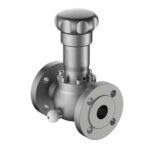
Pressure Relief Valve
Pressure Relief Valve
Dual rail system for smooth strokes and low wear
Leakage is well below API2000 standards and guarantees high setting accuracy (±3%).
Full opening at 10% overpressure
Spool and seat assemblies are field replaceable
Supports ANSI, DIN, and HG/T20592~20635~2009 flanges.

Related Products
Related products
- Pressure Vacuum Valves
Vacuum Relief Valve
- End of Line Breather Valves
End of Line Breather Valve

FAQ
Q:What is a closed loop sampler and how does it work?
A closed loop sampler is a safety device used to collect liquid samples from pipelines or storage tanks without exposing operators to hazardous chemicals. Wanan closed loop samplers comply with API MPMS 8.2 standard and feature a sealed design that returns purge fluid back to the process, eliminating VOC emissions.
Q:What certifications does Wanan Technology have for flame arrestors?
Wanan flame arrestors are certified to ISO 16852, ATEX (European Explosive Atmospheres Directive), and EN 12874 standards. We provide type test reports for IIA, IIB, and IIC gas groups. All products are manufactured in our ISO 9001:2015 certified facilities.
Q:Does Wanan Technology supply to major oil companies?
Yes. Wanan Technology is a registered qualified supplier for Sinopec, PetroChina, CNOOC (China), ExxonMobil, LukOil (Russia), ENI (Italy), KazMunayGas (Kazakhstan), and PDVSA (Venezuela), among others.
Q:Where are Wanan Technology factories located?
Wanan Technology has manufacturing facilities in Germany, USA, and China. We also have inventory and sales service centers in UAE to serve Middle East and global customers with fast delivery.
Q:What scenarios are suitable for Wan'an Technology's sealed sampler?
Wan’an Technology’s closed sampler is suitable for liquid sampling scenarios involving toxic and hazardous media in petrochemical, natural gas, oil refinery, and tank farm industries. It complies with API MPMS 8.2 standards, prevents operators from coming into contact with hazardous substances, and meets HSE environmental emission requirements.
Q: What is your typical lead time for standard and customized products?
A: Standard products ship within 2-4 weeks from order confirmation. Custom-engineered solutions typically require 6-8 weeks depending on specification complexity. For urgent projects, we offer expedited production upon request — contact our sales team with your timeline and we will work out a schedule.
Q: What international certifications do your products hold, and can you provide compliance documentation?
A: Our products comply with major international standards including ISO 3170 (petroleum sampling), API MPMS 8.1/8.2, ATEX for explosive atmospheres, ASME, and EAC. DOT and TPED certifications are available for sample cylinders. We provide full certification documentation and material test certificates with every order.
Q: Can I request a sample or trial unit before placing a bulk order?
A: Yes. We offer sample units for evaluation purposes. Upon approval, we ship one or two units so you can verify compatibility with your application, materials, and site conditions before committing to a volume order. Shipping costs may apply depending on destination.
 English
 Russian
 Arabic
 Spanish
 Portuguese
 Chinese