


Optical Oil-in-Water Analyser — WACYS Series
The WACYS is a flanged, in-line optical analyser that measures the oil concentration in the water leaving a crude or product storage tank. It is bolted straight into the drain line, measures continuously with a 0.1 s response and needs no sampling system, sample cooler, bypass loop or analyser shelter. The 4–20 mA output drives the dehydrator controller, so the draw stops on the actual oil breakthrough instead of on a timer.
| 0.1 s Response time | ≤ 5 % Oil in water | 1.6 – 6.0 MPa Design pressure | Ex db IIC T6 Gb IP66, DN06 – DN300 |
Why measure oil in water online?
Water accumulates at the bottom of every crude and product storage tank and has to be drawn off before it reaches the product outlet. Drawing too early wastes product and upsets the tank; drawing too late carries water into the transfer line. The decision depends on one value — the oil concentration in the water leaving the drain — and that value has to be available while the valve is open, not hours later in a laboratory.
Timer-based or volume-based draw-off assumes the water/oil interface behaves the same way every time. In practice it does not: emulsion bands move with throughput, temperature, product batch and the condition of the tank bottom. An analyser in the drain line closes that loop with a measurement instead of an assumption.
- Product loss — stopping the draw at the true breakthrough point instead of leaving a safety margin on every draw.
- Water carry-over — no oil-free water left in the tank, no water sent downstream with the product.
- Effluent compliance — proof that the water sent to the oily-water system is within the permitted oil concentration.
Measuring principle
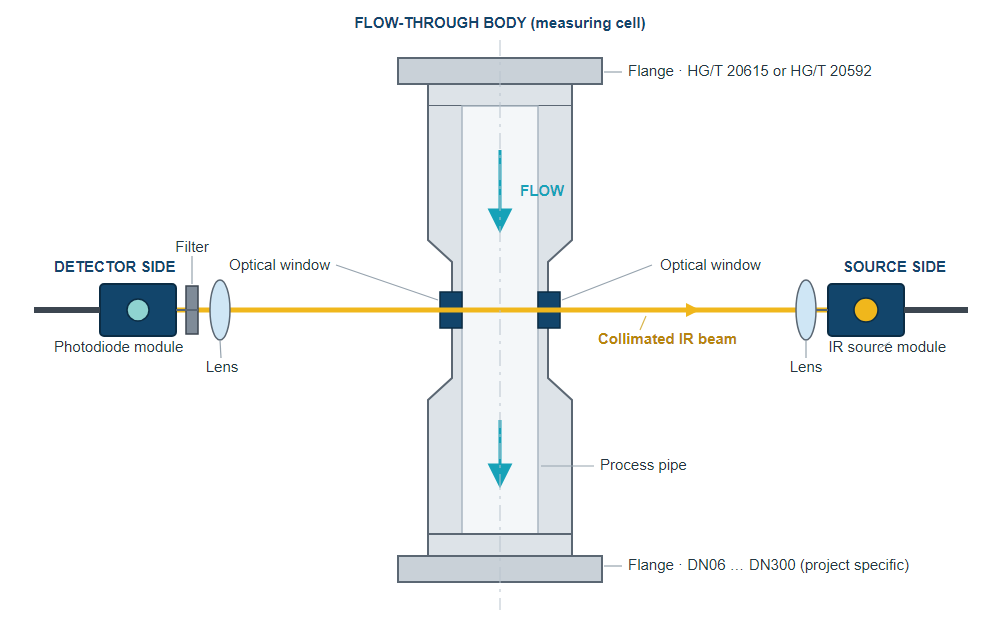
A collimated beam from an infrared source passes through a lens, crosses the flow-through measuring cell at right angles to the flow, and reaches a photodiode through a second lens and an optical filter. The medium absorbs part of the intensity over the optical path length. According to the Lambert–Beer law the logarithm of the loss in transmittance is proportional to the concentration of the absorbing medium, so the photocurrent generated by the detector is a direct measure of the oil concentration in the water.
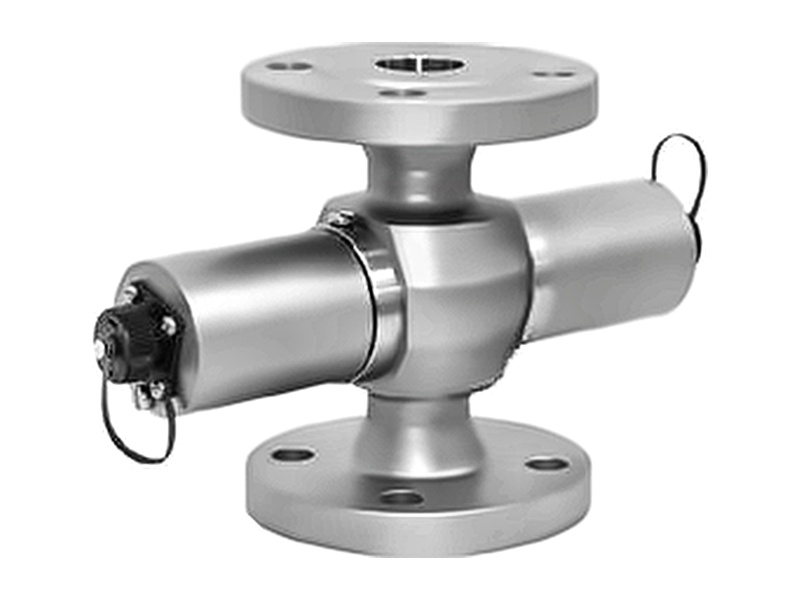
Source and detector sit in separate flameproof modules on a common horizontal optical axis. The optics are isolated from the process by the two windows in the cell body: nothing but the windows is exposed to the medium, and the modules can be serviced without breaking the process line. Measurement is independent of colour, density, conductivity, dielectric constant or viscosity, which is why one instrument covers gasoline, reformate, alkylate, diesel, crude and most other products handled in a tank farm.
Key features
- Fast response — 0.1 s. No sampling lag and no averaging window long enough to delay a decision, which is what makes closed-loop valve control possible.
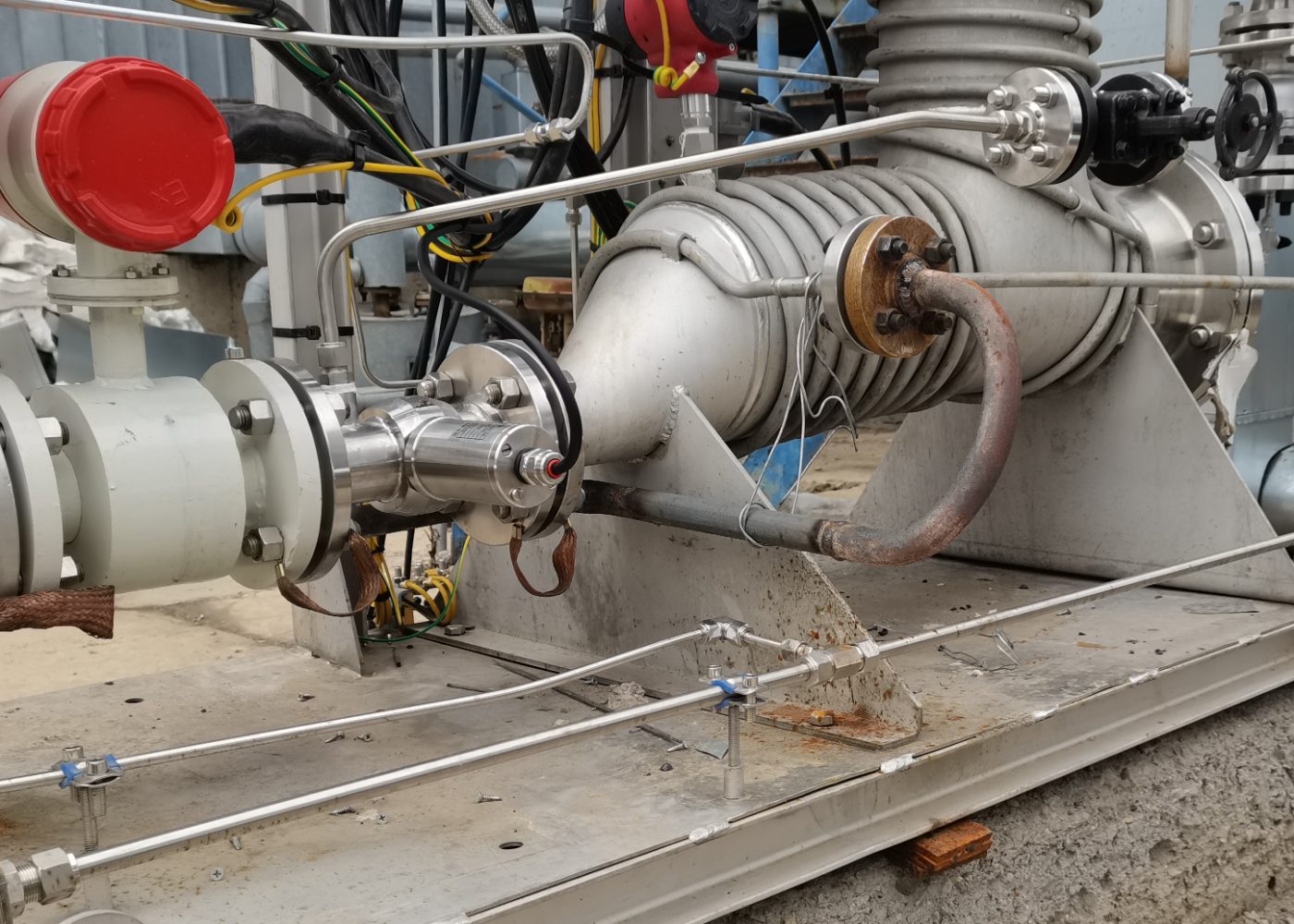
- Installed directly in the line. No sample cooler, bypass loop, pump or analyser shelter. Bolt the spool in, wire the two modules to the control box, and it measures.
- Fully online, maintenance-free operation. Continuous measurement with real-time display; with sleep-mode control the light source is energised only when a measurement is required.
- Hazardous-area ready. Flameproof enclosure rated Ex db IIC T6 Gb, suitable for the zones normally classified around storage tanks and drain headers.
- Designed for the pressure of the drain line. Design pressure up to 6 MPa — well above the design pressure of the tank itself, so the analyser never becomes the pressure limitation of the draw-off system.
- Suits virtually all stored products. Petrol, reformate, alkylate, diesel, jet fuel, crude and most other hydrocarbons.
- Long service life. More than three years in continuous operation, or more than ten years with sleep-mode control.
- Standard 4–20 mA interface. The companion control box converts the photocurrent into a 4–20 mA signal for the PLC or DCS of the dehydration package.
Technical data
| Measurement | |
|---|---|
| Measured variable | Oil concentration in water |
| Measuring principle | Infrared absorption (model code HZ) or fluorescence (model code YG) |
| Measuring range | ≤ 5 % oil in water |
| Response time | 0.1 s |
| Optical and electronic | |
| Light source | Infrared source, DC 3.7 V, 3 W |
| Detector | Photodiode; resistance change 2 … 50 GΩ |
| Signal from sensor | Photocurrent of the detector module |
| Signal to control system | 4–20 mA from the control box (companion product, ordered separately) |
| Process connection | |
| Flange standard | HG/T 20615 (ASME pattern) or HG/T 20592 (EN pattern), selectable |
| Nominal line size | DN06 … DN300, selectable |
| Design pressure | 1.6 … 6.0 MPa, selectable |
| Medium and environment | |
| Medium temperature | 10 °C ≤ Ta ≤ 60 °C; 40 °C ≤ Ta ≤ 60 °C recommended |
| Ambient conditions | Determined by the pour point of the medium; where ambient temperature may fall below it, insulation or electrical heat tracing is required |
| Degree of protection | IP66 |
| Explosion protection | Ex db IIC T6 Gb |
| Electrical supply | |
| Sensor supply | DC 3.7 V |
| Control box supply | DC 24 V |
| Power consumption | 3 W (light source) |
| Service life | |
| Expected service life | More than 3 years in continuous operation; more than 10 years with sleep-mode control |
Values as stated apply to the standard range. Wetted-material certificates, dimensional drawings and any project-specific data are issued with the order acknowledgement.
Model code and ordering information
The model code identifies measuring principle, flange type, nominal size and pressure class:
WACYS – [principle] – [flange][size] – [pressure]
| Field | Meaning |
|---|---|
| WACYS | Optical oil-in-water analyser, Wanan |
| Principle | HZ = infrared absorption; YG = fluorescence |
| Flange type | A = HG/T 20615 flange; G = HG/T 20592 flange |
| Size | Nominal size in mm × 10 — e.g. 50 = DN50 (DN06 … DN300 available) |
| Pressure | Pressure class in bar × 10 — e.g. 16 = 1.6 MPa (1.6 … 6 MPa available) |
Example: WACYS-HZ-A50-16 — optical oil-in-water analyser, infrared absorption, HG/T 20615 flange, DN50, design pressure 1.6 MPa.
Information required with an enquiry:
- Maximum working pressure of the pipeline (MPa).
- Flange standard and nominal size of the mating flanges.
- Available installation space, or the overall dimensions required.
- Medium flow rate (m³/h).
- Medium and expected operating temperature, so that the recommended window is respected.
Applications
- Automatic tank dehydration — oil-in-water feedback to the dehydrator control system on the draw-off line of crude, gasoline, reformate, alkylate and similar service.
- Interface monitoring — continuous indication of water-layer breakthrough on tank drain headers and closed-drain systems.
- Water draw-off quality control — verification that the water sent to the oily-water system is within the permitted oil concentration.
- General impurity concentration — any application where the dispersed phase and the carrier medium absorb infrared radiation to different degrees.
The analyser is normally supplied as part of a tank dehydration package, together with floating suction units and the associated drain-line valves and control box.
Installation and commissioning
Mechanical installation
- Check that the flange standard and size of the analyser match the flanges on the line before installation.
- Bolt the analyser between the pipe flanges in the normal way, with a gasket on each side.
- Support the piping on both sides. The analyser must never carry the weight or the expansion of the line.
- The two mating flanges must be parallel — do not pull the piping into alignment, since bending moment and torque distort the body and misalign the optics.
- Keep the source module and the detector module in the same horizontal plane, so that solids do not settle on the optical windows.
Electrical connection
- Connect the cables of the source module and the detector module to the corresponding terminals of the control box — do not cross or reverse the connections.
- Feed the control box with DC 24 V and take its 4–20 mA output to the PLC of the dehydration package.
- Connect the external earth stud to the earthing point of the equipment, and the internal earth stud to the connector earth pin with flexible copper wire.
Commissioning
After the line is pressurised, check that both modules are powered and that a stable reading is obtained with clean water in the cell. Set the zero point with a clean water sample — never with air — and confirm the 4–20 mA output at the control system. Record the reading at zero and at the expected full-scale condition as the reference for later checks.
Operation and maintenance
The analyser runs continuously and unattended. Where the dehydration package uses sleep-mode control, the light source is switched on only for the measurement interval — the configuration that takes the expected service life beyond ten years. Routine work is limited to:
- Periodic visual check of the optical windows through the cell; clean when the reading drifts or a deposit is visible.
- Verification of the zero point during scheduled tank maintenance.
- Replacement of the light source module at the end of its service life, without removing the body from the line.
Frequently asked questions
What does the analyser actually measure?
The oil concentration in the water leaving the tank drain, expressed as a percentage of oil in water over a range of up to 5 %. It is a direct optical absorption measurement in the line, not a laboratory analysis and not an inferred value from flow or time.
Why infrared absorption rather than another measuring principle?
Online oil-in-water measurement can be based on colour, density, conductivity, dielectric constant, thermal conductivity, specific heat, viscosity, microwave absorption or ultrasonic response. In a tank drain line every one of these is disturbed by emulsification, salinity swings, entrained gas or a change of stored product; infrared absorption is considerably less sensitive to those influences. Its one practical limitation is window fouling, which is addressed by the optical glass grade and the anti-adhesion surface treatment used on the WACYS windows.
Is a separate sampling system or analyser house required?
No. The analyser is a flanged spool piece installed directly in the drain line. Only the control box, which converts the photocurrent into 4–20 mA, is mounted separately — normally inside the flameproof enclosure of the dehydration package.
Which flange standards and sizes are available?
HG/T 20615 (ASME pattern) or HG/T 20592 (EN pattern) flanges, from DN06 to DN300, with design pressure selectable from 1.6 to 6.0 MPa. Other standards can be quoted on request.
How often does the instrument need attention?
Routine attention is limited to a periodic visual check of the windows and a zero-point verification during tank maintenance. In continuous operation the expected service life is more than three years; with sleep-mode control it exceeds ten years.
Can it be used on an existing tank, not only on new builds?
Yes. The analyser is installed in the drain line rather than inside the tank, so it can be added to an existing dehydration system during a shutdown without work inside the tank.
Request a quotation
Send us the line size, flange standard, design pressure, flow rate and product handled, and we will return a model code, dimensional drawing and price. Product data sheets and explosion-protection certificates are available on request.
E-mail: info@wanantec.com · Tel: +86-27-8194-8788 · Contact our engineering team
 English
 Russian
 Arabic
 Spanish
 Portuguese
 Chinese