


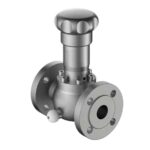
Eco-Type Gauging Hatch
Eco-Type Gauging Hatch
Eco-Type Gauging Hatch — DN200, ASME B16.5 Class 150 RF
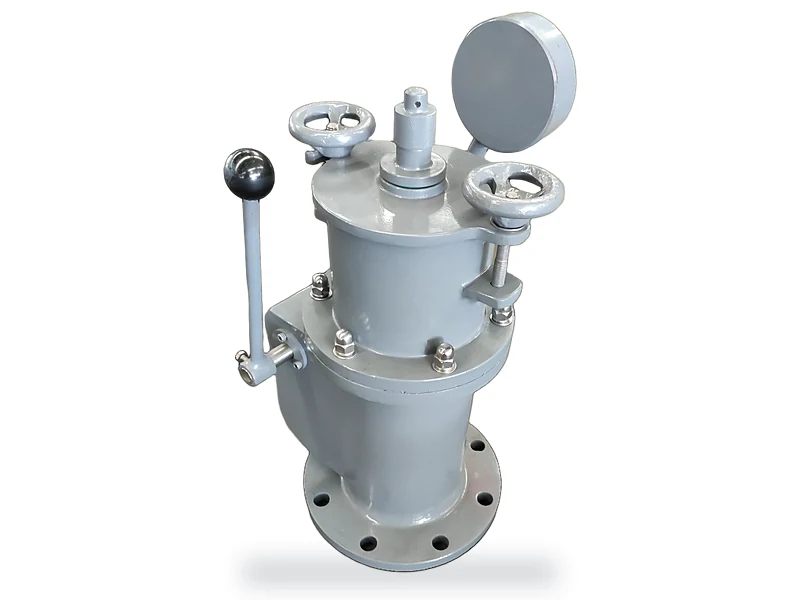
The WANAN eco-type gauging hatch is a vapour-tight gauging port for atmospheric storage tanks. It lets the operator gauge liquid level, measure water bottom, take a temperature reading or draw a sample without releasing product vapour to atmosphere — protecting both the environment and the people working on the tank roof from hydrocarbon exposure.
The body is a single ductile iron casting with an ASME B16.5 Class 150 raised-face flange. The cover is counter-weighted and spring-assisted: it opens through a 90° arc, stays open while the tape is lowered, and closes onto a PTFE seat to restore the vapour seal. Every hatch is tightness-tested at +6 000 Pa before delivery.
| DN200 (8″) Nominal size | CL150 RF ASME B16.5 flange | +6 000 Pa Tightness test | SS304 / PTFE Wetted trim |
Why replace an open gauge hatch?
Every open gauging hatch on a tank roof is an uncontrolled vapour connection. Hydrocarbons escape each time the cover is lifted for a level reading, a water-bottom check or a sample, and the vapour cloud collects around the operator’s position on the roof. Beyond the product loss, that leakage is the usual cause of odour complaints around tank farms and of failures in emission inspections.
The eco-type hatch closes that path. The cover seals on a PTFE gasket, the guide slot lets the tape pass without propping the cover open, and the counterweight keeps the cover clear of the operator’s hands during the measurement. The result is a gauging point that behaves like a closed system in normal service, while remaining as quick to use as an open hatch.
Construction and working principle
The lower body carries the tank flange and the seating face. A PTFE gasket sits in the body groove and a matching PTFE cover seal is recessed into the cover plate, so the two sealing faces close metal-to-PTFE rather than metal-to-metal. The cover plate hinges on a swivel shaft with a lifting spindle; a counterweight and an SS304 chain hold it open through the full 90° arc. The slide slot in the cover is sized for standard gauging tapes and sampling bottles, and a guide plate keeps the tape centred on the dip point.
Because the wetted parts are SS304 and PTFE, the hatch suits crude oil, gasoline, diesel, jet fuel, solvents, aromatics and alcohols, as well as corrosive service where a painted carbon steel hatch would degrade. The ductile iron body provides the flange stiffness and impact resistance needed on a tank roof at a fraction of the cost of a fully stainless body.
Technical specifications
| Parâmetro | Especificações |
|---|---|
| Produto | Eco-type gauging hatch (vapour-tight gauge hatch cover) |
| Nominal size | DN200 (8″), other sizes on request |
| Flange | ASME B16.5 Class 150 raised face, 8-Φ22 bolt holes; JIS / DIN / EN on request |
| Tightness | +6 000 Pa air test on every unit, no leakage permitted |
| Body / cover material | Ductile iron body and cover plate, stainless steel wetted trim |
| Wetted trim | SS304 guide plate, slide slot, chain, hinge and fasteners; PTFE seat and cover seal |
| Cover opening | 90° arc, counter-weighted, spring assisted, chain retained |
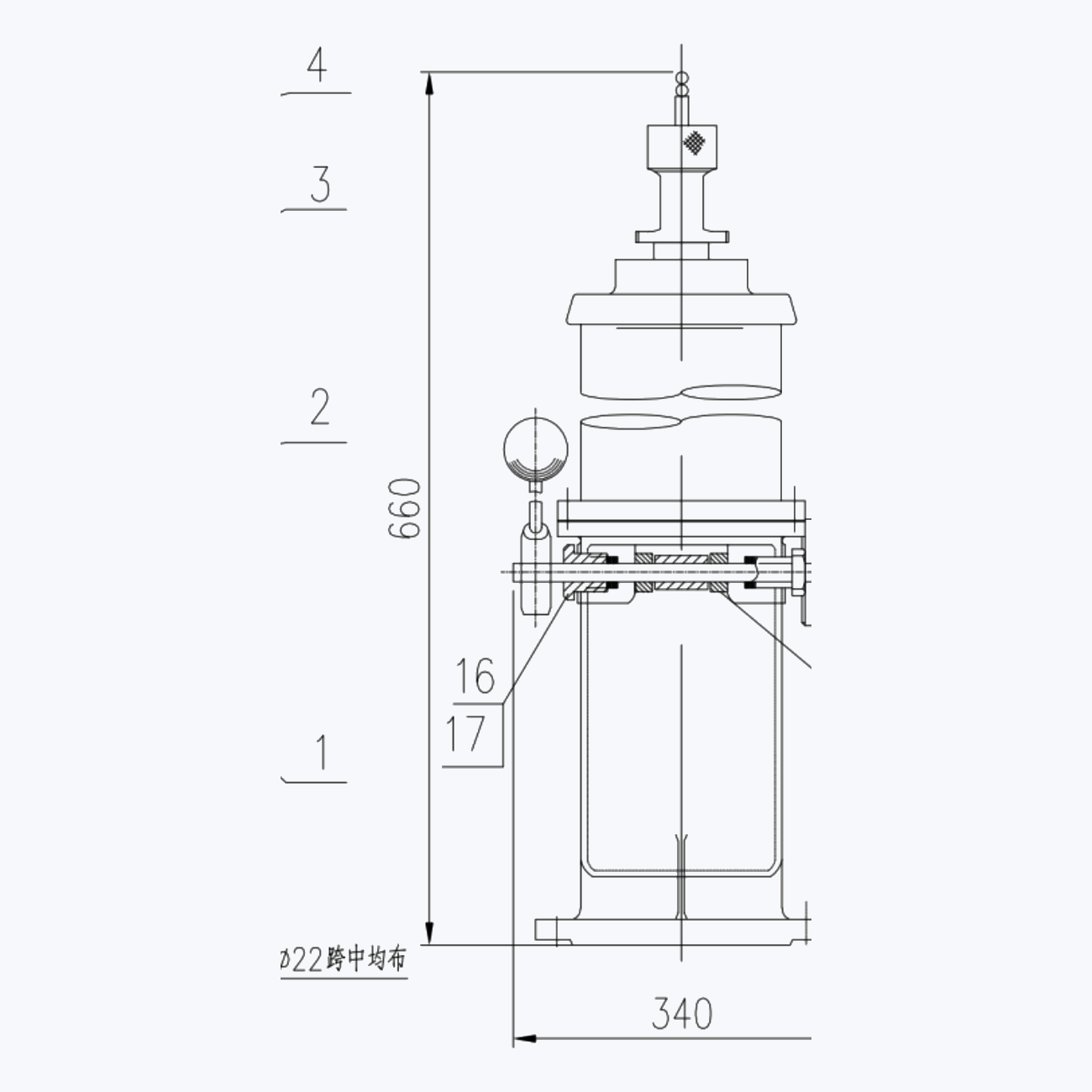
| Cover OD / neck OD | Φ345 mm / Φ298.5 mm |
| Dimensões gerais | L 660 mm × H 340 mm |
| Serviço | Atmospheric storage tanks — crude, gasoline, diesel, jet fuel, solvents, aromatics, alcohols |
| Drawing reference | HN-2021-A |
Component materials
| Item | Componente | Material |
|---|---|---|
| 1 / 6 | Body (lower) / cover plate | Ductile iron |
| 2 / 4 | Body gasket / cover seal | PTFE |
| 3 / 9 | Handwheel / swivel shaft | Ductile iron |
| 5 / 7 / 8 | Seal cover / slide slot / lifting spindle | SS304 |
| 10 | Valve plug with O-ring, Φ10 | Ductile iron |
| 11 / 12 / 14 / 15 / 16 / 17 / 18 | Guide plate, swivel shaft, retaining ring, pin Φ4×20, chain, plug, housing | SS304 |
| 13 | Wheel axle M12×90 | Steel, zinc plated |
Other sizes, materials and flange standards can be quoted on request.
Where it is used
- Refinery and terminal tank farms — fixed roof and floating roof tanks handling crude oil, gasoline, diesel and jet fuel.
- Petrochemical and chemical storage — solvents, aromatics, alcohols and other volatile products where vapour release must be controlled.
- New tank construction — supplied as the roof gauging nozzle closure, matched to the nozzle flange schedule.
- Retrofit of open hatches — replacement of leaking or non-sealing gauging hatches during tank turnaround, without modification of the roof nozzle.
Instalação
- Mount the hatch vertically on the tank roof gauging nozzle — mating flange ASME B16.5 Class 150 RF, DN200.
- Tighten the eight bolts evenly in a cross pattern so that the PTFE gasket is compressed uniformly around the full face.
- Check that the cover swings freely through its full arc, that the counterweight holds it open, and that the chain is correctly anchored to the body.
- Carry out a leak check at the flange joint and around the cover seal before the tank is put back into service.
Operação e manutenção
- Release the latch and lift the cover — the counterweight holds it open through 90°.
- Lower the gauging tape or sampling bottle through the slide slot; the guide plate keeps the tape centred on the dip point.
- Gauge level, measure water bottom, take temperature or draw the sample as required.
- Close the cover firmly after each operation so that the PTFE seal is re-established.
- Inspect the PTFE gasket and cover seal at each tank inspection and replace them if they are cut, compressed or contaminated.
Perguntas frequentes
What is the difference between an eco-type gauging hatch and a standard gauge hatch?
An eco-type hatch seals on a PTFE gasket and is tested for tightness at +6 000 Pa, so vapour cannot escape when the cover is closed. A conventional open hatch has a loose cover and vents the tank continuously; it cannot pass an emission inspection on a volatile product.
Does the hatch interfere with level gauging or sampling?
No. The slide slot in the cover is sized for standard gauging tapes and sampling bottles, and the guide plate keeps the tape centred. The counterweighted cover stays open through 90° so the operator has both hands free for the measurement.
Which flange standard is supplied as standard?
ASME B16.5 Class 150 raised face, DN200, with 8-Φ22 bolt holes — 660 mm overall length, 340 mm overall height. JIS, DIN and EN drilling, other sizes and other body materials are available on request.
Can the hatch be fitted to an existing tank?
Yes, provided the roof nozzle flange matches ASME B16.5 Class 150 RF. The hatch is bolted onto the existing nozzle during a tank shutdown; no work inside the tank is needed.
What materials are in contact with the product vapour?
SS304 for the guide plate, slide slot, chain, hinge parts and fasteners, with PTFE for the body gasket and cover seal. The ductile iron body is not exposed to the product because the PTFE gasket seals against the flange face.
Solicite um orçamento
Send us the tank size, roof nozzle flange standard, product handled and the quantity required, and we will return a model code, dimensional drawing and price. A two-page product data sheet with the full component and dimension tables can be downloaded here: Eco-Type Gauging Hatch — Product Data Sheet (PDF).
E-mail: info@wanantec.com · Tel.: +86-27-8194-8788 · Entre em contato com nossa equipe de engenharia
Produtos relacionados
PERGUNTAS FREQUENTES
P: O que é um amostrador de circuito fechado e como ele funciona?
Um amostrador de circuito fechado é um dispositivo de segurança utilizado para coletar amostras de líquidos de dutos ou tanques de armazenamento sem expor os operadores a produtos químicos perigosos. Os amostradores de circuito fechado da Wanan estão em conformidade com a norma API MPMS 8.2 e apresentam um projeto vedado que devolve o fluido de purga de volta ao processo, eliminando as emissões de COV.
P: Quais certificações a Wanan Technology possui para os supressores de chamas?
Os supressores de chamas Wanan são certificados pelas normas ISO 16852, ATEX (Diretiva Europeia sobre Atmosferas Explosivas) e EN 12874. Fornecemos relatórios de ensaio de tipo para os grupos de gases IIA, IIB e IIC. Todos os produtos são fabricados em nossas instalações certificadas pela norma ISO 9001:2015.
P: A Wanan Technology fornece produtos para as principais empresas petrolíferas?
Sim. A Wanan Technology é um fornecedor qualificado e registrado da Sinopec, PetroChina, CNOOC (China), ExxonMobil, LukOil (Rússia), ENI (Itália), KazMunayGas (Cazaquistão) e PDVSA (Venezuela), entre outras empresas.
P: Onde estão localizadas as fábricas da Wanan Technology?
A Wanan Technology possui instalações de fabricação na Alemanha, nos EUA e na China. Também contamos com centros de estoque e atendimento comercial nos Emirados Árabes Unidos para atender clientes do Oriente Médio e de todo o mundo com entregas rápidas.
P: Em que situações o amostrador selado da Wan'an Technology é adequado?
O amostrador fechado da Wan’an Technology é adequado para situações de amostragem de líquidos que envolvam meios tóxicos e perigosos nos setores petroquímico, de gás natural, de refino de petróleo e de parques de tanques. Ele está em conformidade com as normas API MPMS 8.2, evita que os operadores entrem em contato com substâncias perigosas e atende aos requisitos de emissões ambientais da HSE.
P: Qual é o prazo de entrega normal para produtos padrão e personalizados?
R: Os produtos padrão são enviados dentro de 2 a 4 semanas a partir da confirmação do pedido. Soluções personalizadas geralmente levam de 6 a 8 semanas, dependendo da complexidade das especificações. Para projetos urgentes, oferecemos produção acelerada mediante solicitação — entre em contato com nossa equipe de vendas informando seu prazo e definiremos um cronograma.
P: Quais certificações internacionais seus produtos possuem? Vocês podem fornecer a documentação de conformidade?
R: Nossos produtos estão em conformidade com as principais normas internacionais, incluindo a ISO 3170 (amostragem de petróleo), API MPMS 8.1/8.2, ATEX para atmosferas explosivas, ASME e EAC. As certificações DOT e TPED estão disponíveis para cilindros de amostragem. Fornecemos toda a documentação de certificação e certificados de ensaio de materiais em cada pedido.
P: Posso solicitar uma amostra ou uma unidade de teste antes de fazer um pedido em grande quantidade?
R: Sim. Oferecemos unidades de amostra para fins de avaliação. Após a aprovação, enviamos uma ou duas unidades para que você possa verificar a compatibilidade com sua aplicação, materiais e condições do local antes de confirmar um pedido em grande quantidade. Podem ser cobrados custos de frete, dependendo do destino.
 English
 Russian
 Arabic
 Spanish
 Portuguese
 Chinese